
Ch. 6 - Stereoisomerism: Arrangement of Atoms in Space
Mullins - Organic Chemistry: A Learner Centered Approach 1st Edition
Mullins1st EditionOrganic Chemistry: A Learner Centered ApproachISBN: 9780137566471Not the one you use?Change textbook
Chapter 5, Problem 63

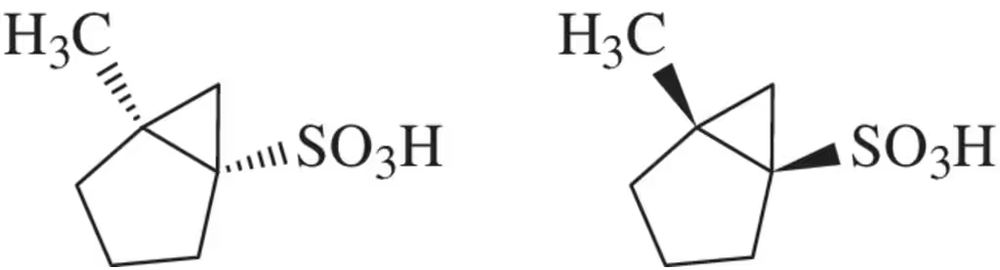
A chemist prepared a racemic mixture of the enantiomeric sulfonic acids shown here. Suggest two ways that these might be separated.
Two enantiomeric sulfonic acids are illustrated, showing their distinct structures and functional groups.

Verified step by step guidance
1
Understand the problem: A racemic mixture contains equal amounts of two enantiomers, which are non-superimposable mirror images of each other. The goal is to separate these enantiomers into their pure forms. This process is called resolution.
Step 1: Use a chiral resolving agent. React the racemic mixture with a chiral base or chiral alcohol to form diastereomeric salts or esters. Diastereomers have different physical properties (e.g., solubility, melting point), allowing them to be separated by physical methods such as crystallization.
Step 2: Perform chromatographic separation using a chiral stationary phase. In this method, the racemic mixture is passed through a column containing a chiral stationary phase. The enantiomers interact differently with the chiral environment, leading to their separation as they elute at different rates.
Step 3: After separation, regenerate the original enantiomers. For example, if diastereomeric salts were formed, treat them with an acid or base to recover the individual enantiomers of the sulfonic acids.
Step 4: Verify the purity of the separated enantiomers. Use techniques such as polarimetry to measure optical rotation or NMR spectroscopy with a chiral shift reagent to confirm the enantiomeric excess and purity of the separated compounds.

Verified video answer for a similar problem:

This video solution was recommended by our tutors as helpful for the problem above.
Video duration:
2m
Was this helpful?

Key Concepts

Here are the essential concepts you must grasp in order to answer the question correctly.

Racemic Mixture

A racemic mixture contains equal amounts of two enantiomers, which are molecules that are mirror images of each other. These compounds often exhibit different properties, particularly in chiral environments, such as biological systems. Understanding the nature of racemic mixtures is crucial for developing methods to separate enantiomers effectively.
Recommended video:
Guided course
03:08
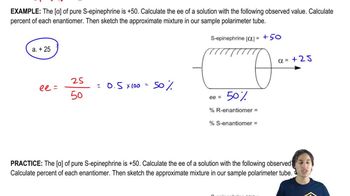
Calculating EE, percent of each enantiomer, and sketching mixture

Chiral Separation Techniques

Chiral separation techniques exploit the differences in the behavior of enantiomers in chiral environments. Common methods include chromatography using chiral stationary phases and resolution through diastereomer formation. These techniques are essential for isolating enantiomers from racemic mixtures, allowing for the study and application of each enantiomer's unique properties.
Recommended video:
Guided course
05:10
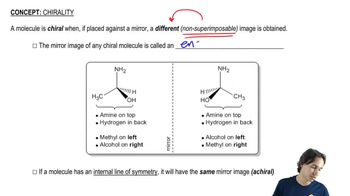
What is chirality?

Enantiomers and Optical Activity

Enantiomers are compounds that are non-superimposable mirror images of each other and often exhibit different optical activities. This means that they rotate plane-polarized light in opposite directions, a property that can be used to distinguish between them. Understanding optical activity is vital for identifying and separating enantiomers in a racemic mixture.
Recommended video:
Guided course
08:17
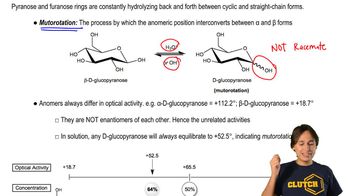
Mutorotation and Optical Activity