
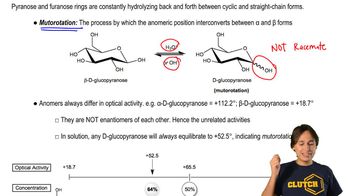
A chemist working on the synthesis of (+)-pilocarpine, an alkaloid used in the treatment of dry mouth and glaucoma, produced a mixture of enantiomers that gave a specific rotation [α]D = +97°. Based on the specific rotation of the pure enantiomer, calculate the ratio of (+)- to (-)-pilocarpine produced by the chemist.

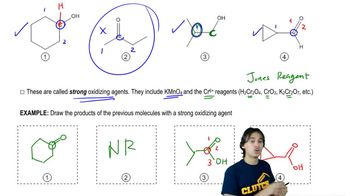
In Chapter 13, we explain how to convert secondary alcohols into ketones using a mild oxidation reaction. When the following enantiomerically pure and optically active secondary alcohol is submitted to these reaction conditions, the product is optically inactive. Explain this observation.

Verified step by step guidance
Verified video answer for a similar problem:
Key Concepts
Chirality and Optical Activity
Oxidation of Alcohols
Formation of Achiral Compounds
Chromatography using a chiral stationary phase is able to separate a pair of enantiomers because one of the enantiomers forms a more tightly bound complex with the stationary phase. Assuming that the (S) enantiomer elutes more slowly, rationalize this result on a reaction coordinate diagram.
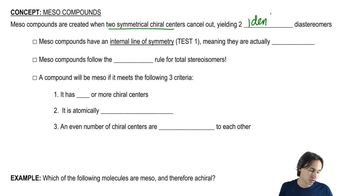
A compound with two chiral centers that is meso will always have opposite absolute configurations at the two chiral centers. That is, a meso compound will never be (R,R) or (S,S); instead, it will be (R,S). Explain why this must be true.
In contrast to Assessment 6.63, the following compounds should be easily separable using standard methods. Why?
A chemist prepared a racemic mixture of the enantiomeric sulfonic acids shown here. Suggest two ways that these might be separated.
In Chapter 12, we introduce the SN2 reaction, a nucleophilic substitution reaction that proceeds with inversion. Confirm that inversion has occurred in each of the following examples by determining the absolute configuration of the chiral center in the reactants and products.
(a)
