Ch. 6 - Stereoisomerism: Arrangement of Atoms in Space
Mullins - Organic Chemistry: A Learner Centered Approach 1st Edition
Mullins1st EditionOrganic Chemistry: A Learner Centered ApproachISBN: 9780137566471Not the one you use?Change textbook
Chapter 5, Problem 42a

Convert the line-angle drawings into Fischer projections.
(a)

Verified step by step guidance
1
Step 1: Analyze the line-angle drawing provided. The molecule is a carbon chain with two chlorine atoms attached to the central carbon. The wedge and dash bonds indicate stereochemistry, where the wedge bond represents a group coming out of the plane (towards the viewer) and the dash bond represents a group going behind the plane (away from the viewer).
Step 2: Identify the substituents on the central carbon atom. The central carbon is bonded to a chlorine atom (on the wedge), another chlorine atom (on the dash), a methyl group (CH₃), and another methyl group (CH₃).
Step 3: Orient the molecule to prepare for conversion into a Fischer projection. In a Fischer projection, the horizontal bonds represent groups coming out of the plane, and the vertical bonds represent groups going behind the plane. Rotate the molecule mentally or on paper to align it with this convention.
Step 4: Assign the substituents to the appropriate positions in the Fischer projection. Place the chlorine atoms on the horizontal axis (since they are on the wedge and dash bonds), and place the methyl groups on the vertical axis (since they are in the plane of the paper).
Step 5: Draw the Fischer projection. The central carbon is represented as a cross, with the chlorine atoms on the left and right (horizontal axis) and the methyl groups on the top and bottom (vertical axis). Ensure the stereochemistry is preserved by correctly assigning the wedge and dash bonds to the horizontal axis.

Verified video answer for a similar problem:

This video solution was recommended by our tutors as helpful for the problem above.
Video duration:
5m
Was this helpful?

Key Concepts

Here are the essential concepts you must grasp in order to answer the question correctly.

Line-Angle Drawings

Line-angle drawings, also known as skeletal structures, are a shorthand representation of organic molecules where vertices represent carbon atoms and lines represent bonds. This method simplifies the depiction of complex molecules by omitting hydrogen atoms attached to carbons, making it easier to visualize the overall structure and connectivity of the molecule.
Recommended video:
Guided course
02:46
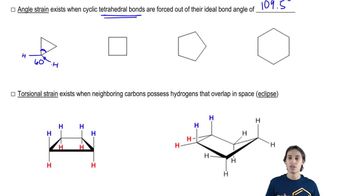
What is angle strain?

Fischer Projections

Fischer projections are a two-dimensional representation of three-dimensional organic molecules, particularly useful for depicting stereochemistry. In this format, the vertical lines represent bonds that are oriented away from the viewer, while horizontal lines represent bonds that are coming towards the viewer. This projection is especially important for illustrating the configuration of chiral centers in carbohydrates and amino acids.
Recommended video:
Guided course
09:56
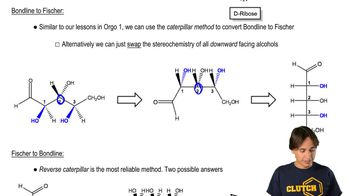
Monosaccharides - Drawing Fischer Projections

Stereochemistry

Stereochemistry is the study of the spatial arrangement of atoms in molecules and how this affects their chemical behavior. Understanding stereochemistry is crucial when converting between line-angle drawings and Fischer projections, as it involves recognizing the orientation of substituents around chiral centers. Properly representing stereochemistry ensures accurate communication of molecular structure and reactivity.
Recommended video:
1:38
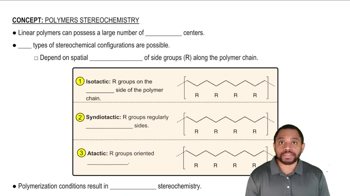
Polymer Stereochemistry Concept 1