
Textbook Question
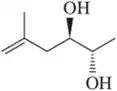
A molecule of the type shown is discussed in greater detail in Section 6.5.1. Although it contains at least one atom with four different groups attached, why is it not a chiral molecule?
957
views

 Verified step by step guidance
 05:10
05:10
 03:23
03:23 1:38
1:38A molecule of the type shown is discussed in greater detail in Section 6.5.1. Although it contains at least one atom with four different groups attached, why is it not a chiral molecule?
Identify the following substituted cycloalkanes as cis or trans.
(a)
A molecule of the type shown here is discussed in greater detail in Section 6.5.1. Draw the mirror image. Is it superimposable? Switch the spatial orientation at both asymmetric centers. Have you generated a new molecule?
Draw the mirror image of the following molecule. Then, using the mirror image generated, switch the spatial orientation at the asymmetric center. Is the final structure the enantiomer of the original? If not, what is it?
Identify the following molecules as chiral or achiral. If chiral, draw the nonsuperimposable mirror image and verify its nonsuperimposability.
(f)
For each of the following chiral molecules, obtain the enantiomer (i) by drawing the nonsuperimposable mirror image and (ii) by switching the spatial orientation at each asymmetric center. Confirm (possibly using models) that the structures you drew for (i) and (ii) are the same.
(b)