Ch. 6 - Stereoisomerism: Arrangement of Atoms in Space
Mullins - Organic Chemistry: A Learner Centered Approach 1st Edition
Mullins1st EditionOrganic Chemistry: A Learner Centered ApproachISBN: 9780137566471Not the one you use?Change textbook
Chapter 5, Problem 17a

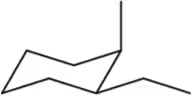
Identify the following substituted cycloalkanes as cis or trans.
(a) Structural representation of a substituted cycloalkane, illustrating cis and trans configurations.

Verified step by step guidance
1
Step 1: Understand the concept of cis and trans isomers. Cis isomers have substituents on the same side of the cycloalkane ring, while trans isomers have substituents on opposite sides of the ring.
Step 2: Examine the structure of the substituted cycloalkane provided in the problem. Identify the positions of the substituents relative to the plane of the ring (above or below).
Step 3: Determine whether the substituents are on the same side (cis) or opposite sides (trans) of the ring. This can be done by visualizing or drawing the molecule in 3D.
Step 4: If the substituents are on the same side, label the molecule as cis. If they are on opposite sides, label the molecule as trans.
Step 5: Double-check your analysis by considering the spatial arrangement of the substituents and ensuring the correct identification of cis or trans isomers.

Verified video answer for a similar problem:

This video solution was recommended by our tutors as helpful for the problem above.
Video duration:
4m
Was this helpful?

Key Concepts

Here are the essential concepts you must grasp in order to answer the question correctly.

Cis-Trans Isomerism

Cis-trans isomerism, also known as geometric isomerism, occurs in compounds with restricted rotation around a bond, typically in alkenes or cyclic structures. In cycloalkanes, 'cis' refers to substituents on the same side of the ring, while 'trans' indicates they are on opposite sides. This spatial arrangement significantly affects the physical and chemical properties of the compounds.
Recommended video:
Guided course
00:44
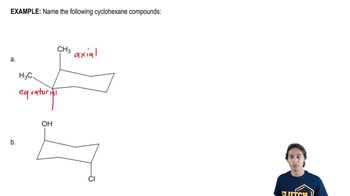
Is the following cyclohexane cis or trans?

Cycloalkanes

Cycloalkanes are saturated hydrocarbons with carbon atoms arranged in a ring structure. They can vary in size and the number of carbon atoms, influencing their stability and reactivity. The presence of substituents on the ring can lead to different isomeric forms, which are crucial for determining their classification as cis or trans.
Recommended video:
Guided course
01:11
How to find the root name for cycloalkanes

Substituents and Their Position

In the context of cycloalkanes, substituents are atoms or groups attached to the carbon ring. The position of these substituents relative to each other is essential for determining whether the compound is classified as cis or trans. Understanding how to identify and visualize these positions is key to accurately categorizing the isomers.
Recommended video:
4:06
Reactions at the Allylic Position Example 3