Ch. 6 - Stereoisomerism: Arrangement of Atoms in Space
Mullins - Organic Chemistry: A Learner Centered Approach 1st Edition
Mullins1st EditionOrganic Chemistry: A Learner Centered ApproachISBN: 9780137566471Not the one you use?Change textbook
Chapter 5, Problem 11b

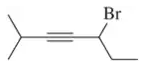
For each of the following molecules, identify all stereocenters and draw all possible stereoisomers.
(b)

Verified step by step guidance
1
Step 1: Analyze the molecular structure provided. The molecule contains a bromine atom attached to a carbon, along with a triple bond and other substituents. Identify any stereocenters by looking for carbons bonded to four different groups.
Step 2: Determine if the molecule contains stereocenters. A stereocenter is a carbon atom that is bonded to four distinct groups. In this molecule, the carbon attached to the bromine atom is a stereocenter because it is bonded to a bromine, a methyl group, an ethyl group, and the rest of the molecule.
Step 3: Consider the triple bond. Triple bonds do not exhibit cis-trans isomerism because the linear geometry of the bond does not allow for restricted rotation. Therefore, the triple bond does not contribute to stereoisomerism.
Step 4: Calculate the number of possible stereoisomers. For each stereocenter, there are two possible configurations (R and S). Since there is one stereocenter in this molecule, there are 2^1 = 2 possible stereoisomers.
Step 5: Draw the stereoisomers. Represent the molecule with the bromine atom in both R and S configurations. Use wedge and dash bonds to indicate the spatial arrangement of the substituents around the stereocenter.

Verified video answer for a similar problem:

This video solution was recommended by our tutors as helpful for the problem above.
Was this helpful?

Key Concepts

Here are the essential concepts you must grasp in order to answer the question correctly.

Stereocenters

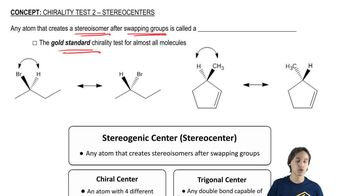
Stereocenters, or chiral centers, are atoms in a molecule that have four different substituents attached to them, leading to non-superimposable mirror images. In organic chemistry, these centers are crucial for determining the molecule's chirality, which affects its optical activity and interactions with other chiral substances.
Recommended video:
Guided course
02:15
What is a stereocenter?

Stereoisomers

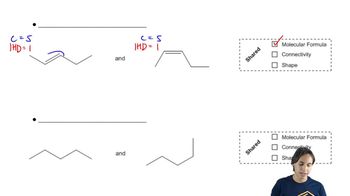
Stereoisomers are compounds that have the same molecular formula and connectivity of atoms but differ in the spatial arrangement of their atoms. This category includes enantiomers, which are mirror images of each other, and diastereomers, which are not mirror images. The number of stereoisomers can be calculated using the formula 2^n, where n is the number of stereocenters.
Recommended video:
Guided course
01:58
Determining when molecules are stereoisomers.

Drawing Stereoisomers

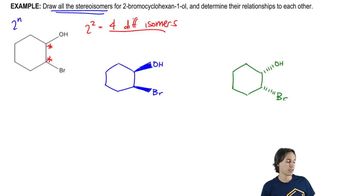
Drawing stereoisomers involves representing the three-dimensional arrangement of atoms in a two-dimensional format. Techniques such as wedge-and-dash notation help illustrate the spatial orientation of substituents around stereocenters. Understanding how to visualize and draw these structures is essential for identifying all possible stereoisomers of a given molecule.
Recommended video:
Guided course
07:41
Draw stereoisomers and determine relationship