Ch. 6 - Stereoisomerism: Arrangement of Atoms in Space
Mullins - Organic Chemistry: A Learner Centered Approach 1st Edition
Mullins1st EditionOrganic Chemistry: A Learner Centered ApproachISBN: 9780137566471Not the one you use?Change textbook
Chapter 5, Problem 12c

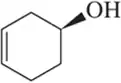
Identify the following molecules as chiral or achiral. If chiral, draw the nonsuperimposable mirror image and verify its nonsuperimposability.
(c) Chemical structure of a hexagonal ring with an attached hydroxyl group, illustrating a molecule for chirality analysis.

Verified step by step guidance
1
Step 1: Understand the concept of chirality. A molecule is chiral if it has a non-superimposable mirror image, which typically occurs when a carbon atom is bonded to four different groups (a stereocenter). If the molecule lacks such a stereocenter or has a plane of symmetry, it is achiral.
Step 2: Analyze the given molecule (c) to determine if it contains any stereocenters. Look for carbon atoms bonded to four distinct groups. If no such carbon exists, the molecule is achiral.
Step 3: If a stereocenter is present, draw the molecule's mirror image. To do this, reflect the molecule across a plane to create the mirror image, ensuring that all groups attached to the stereocenter are reversed in their spatial arrangement.
Step 4: Attempt to superimpose the original molecule and its mirror image. If the two structures cannot be superimposed (i.e., they are distinct in 3D space), the molecule is chiral. If they can be superimposed, the molecule is achiral.
Step 5: Verify your conclusion by checking for symmetry elements. If the molecule has a plane of symmetry or a center of symmetry, it is achiral. If no such symmetry exists and the mirror image is non-superimposable, the molecule is confirmed to be chiral.

Verified video answer for a similar problem:

This video solution was recommended by our tutors as helpful for the problem above.
Video duration:
4m
Was this helpful?

Key Concepts

Here are the essential concepts you must grasp in order to answer the question correctly.

Chirality

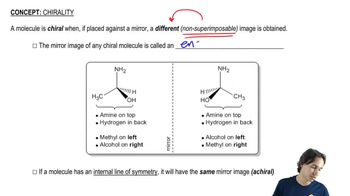
Chirality refers to the geometric property of a molecule that makes it non-superimposable on its mirror image. A chiral molecule typically has a carbon atom bonded to four different substituents, creating two distinct forms known as enantiomers. These enantiomers can exhibit different optical activities, meaning they rotate plane-polarized light in opposite directions.
Recommended video:
Guided course
05:10
What is chirality?

Achirality

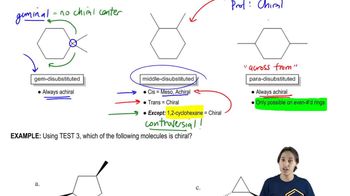
Achirality describes molecules that are superimposable on their mirror images, meaning they do not have a chiral center or possess symmetry that allows for such superimposition. Common examples include molecules with a plane of symmetry or those that are symmetrical in their structure. Understanding achirality is essential for distinguishing between chiral and achiral compounds.
Recommended video:
Guided course
04:48
Cis-1,2-Disubstituted Cyclohexane:A controversial exception.

Nonsuperimposable Mirror Images

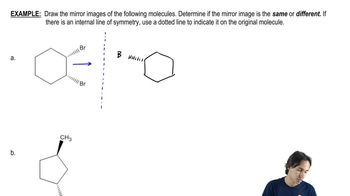
Nonsuperimposable mirror images are pairs of structures that cannot be aligned perfectly with one another, even when rotated or flipped. This concept is crucial in identifying chiral molecules, as it helps to visualize the distinct spatial arrangements of atoms in enantiomers. Drawing these images and verifying their nonsuperimposability is a key step in understanding molecular chirality.
Recommended video:
Guided course
03:24
Drawing Mirror Images and Determining Chirality