Ch. 6 - Stereoisomerism: Arrangement of Atoms in Space
Mullins - Organic Chemistry: A Learner Centered Approach 1st Edition
Mullins1st EditionOrganic Chemistry: A Learner Centered ApproachISBN: 9780137566471Not the one you use?Change textbook
Chapter 5, Problem 18d

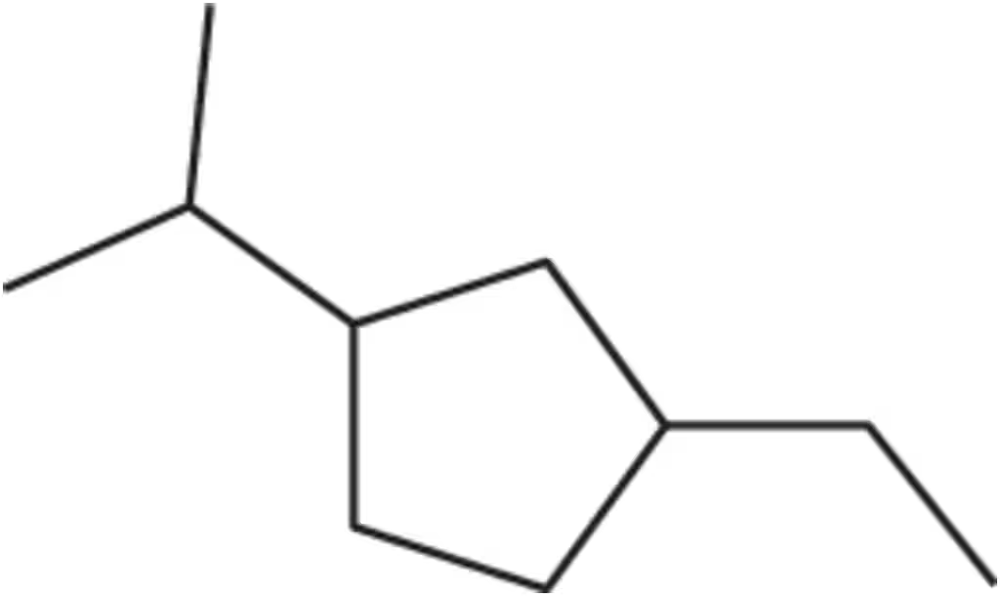
For the compound 1-ethyl-3-isopropylcyclopentane,
Structural representation of 1-ethyl-3-isopropylcyclopentane showing cis and trans isomers.
(d) LOOKING AHEAD What is the relationship between a cis isomer and a trans isomer?

Verified step by step guidance
1
Understand the terms 'cis' and 'trans' isomers: These are types of stereoisomers, which differ in the spatial arrangement of groups around a ring or a double bond. In a 'cis' isomer, the substituents are on the same side of the ring or double bond, while in a 'trans' isomer, the substituents are on opposite sides.
Identify the substituents in 1-ethyl-3-isopropylcyclopentane: The ethyl group is attached to carbon 1 of the cyclopentane ring, and the isopropyl group is attached to carbon 3. The spatial arrangement of these groups determines whether the compound is a cis or trans isomer.
Determine the relationship between the cis and trans isomers: These isomers are stereoisomers, specifically diastereomers, because they are not mirror images of each other and have different physical and chemical properties.
Explain the physical and chemical differences: Cis and trans isomers often have different boiling points, melting points, and solubilities due to the differences in their three-dimensional structures, which affect intermolecular forces.
Conclude the relationship: The cis and trans isomers of 1-ethyl-3-isopropylcyclopentane are diastereomers, and their relationship is defined by the spatial arrangement of the substituents on the cyclopentane ring.

Verified video answer for a similar problem:

This video solution was recommended by our tutors as helpful for the problem above.
Video duration:
8m
Was this helpful?

Key Concepts

Here are the essential concepts you must grasp in order to answer the question correctly.

Cis-Trans Isomerism

Cis-trans isomerism, also known as geometric isomerism, occurs in compounds with restricted rotation around a double bond or a ring structure. In cis isomers, substituents are on the same side of the double bond or ring, while in trans isomers, they are on opposite sides. This spatial arrangement can significantly affect the physical and chemical properties of the compounds.
Recommended video:
Guided course
00:44
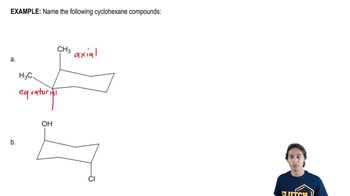
Is the following cyclohexane cis or trans?

Steric Hindrance

Steric hindrance refers to the repulsion between atoms that occurs when they are brought close together, which can affect the stability and reactivity of a molecule. In the context of cis and trans isomers, steric hindrance can be more pronounced in cis isomers due to the proximity of larger substituents, potentially leading to higher energy and lower stability compared to their trans counterparts.
Recommended video:
Guided course
02:53
Understanding steric effects.

Physical Properties of Isomers

Cis and trans isomers often exhibit different physical properties, such as boiling points, melting points, and solubility. For example, cis isomers may have higher boiling points due to stronger dipole-dipole interactions, while trans isomers, being more symmetrical, may pack more efficiently in a solid state, leading to higher melting points. Understanding these differences is crucial for predicting the behavior of organic compounds.
Recommended video:
0:53
Physical Properties of Fatty Acids Concept 1