Ch. 6 - Stereoisomerism: Arrangement of Atoms in Space
Mullins - Organic Chemistry: A Learner Centered Approach 1st Edition
Mullins1st EditionOrganic Chemistry: A Learner Centered ApproachISBN: 9780137566471Not the one you use?Change textbook
Chapter 5, Problem 18b

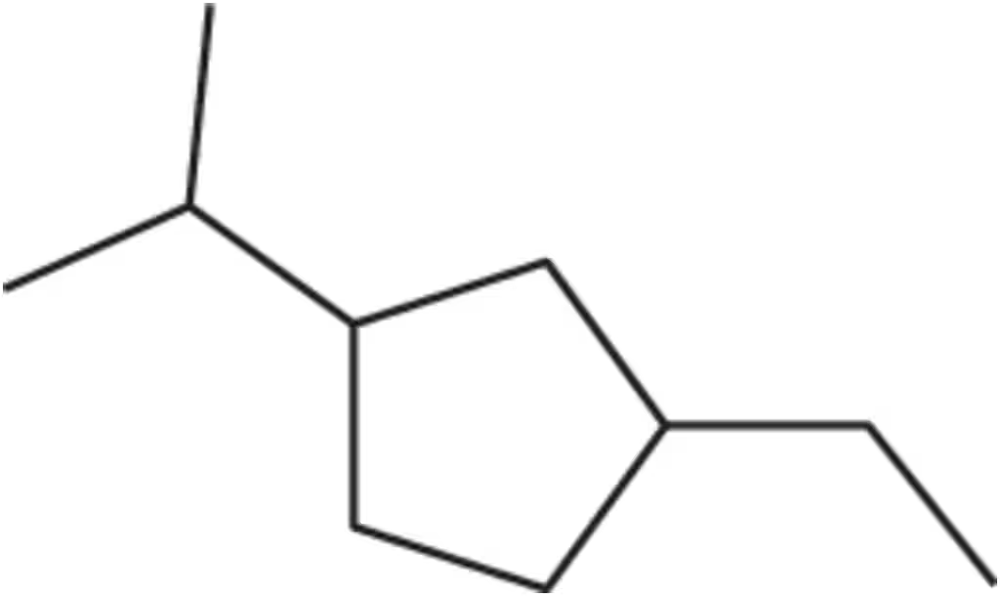
For the compound 1-ethyl-3-isopropylcyclopentane,
Structural representation of 1-ethyl-3-isopropylcyclopentane showing cis and trans isomers.
(b) What is the stereochemical relationship between the cis isomers?

Verified step by step guidance
1
Step 1: Identify the compound structure. The compound 1-ethyl-3-isopropylcyclopentane consists of a cyclopentane ring with an ethyl group at position 1 and an isopropyl group at position 3. The stereochemical relationship between the cis isomers depends on the spatial arrangement of these substituents.
Step 2: Define 'cis isomers.' Cis isomers occur when two substituents are on the same side of the cyclopentane ring. In this case, both the ethyl and isopropyl groups are positioned on the same face of the ring.
Step 3: Analyze the stereochemical relationship. Cis isomers of 1-ethyl-3-isopropylcyclopentane are diastereomers. Diastereomers are stereoisomers that are not mirror images of each other and have different physical and chemical properties.
Step 4: Examine the provided images. The images show two different cis configurations of the compound. The substituents are on the same side of the ring, but the spatial arrangement of the groups differs, confirming that they are diastereomers.
Step 5: Conclude the stereochemical relationship. The cis isomers of 1-ethyl-3-isopropylcyclopentane are diastereomers due to their distinct spatial arrangements while being on the same side of the ring.

Verified video answer for a similar problem:

This video solution was recommended by our tutors as helpful for the problem above.
Video duration:
6m
Was this helpful?

Key Concepts

Here are the essential concepts you must grasp in order to answer the question correctly.

Cis-Trans Isomerism

Cis-trans isomerism, also known as geometric isomerism, occurs in compounds with restricted rotation around a bond, typically a double bond or a ring structure. In cis isomers, substituents are on the same side of the double bond or ring, while in trans isomers, they are on opposite sides. This spatial arrangement can significantly affect the physical and chemical properties of the compounds.
Recommended video:
Guided course
00:44
Is the following cyclohexane cis or trans?

Chirality

Chirality refers to the geometric property of a molecule having non-superimposable mirror images, much like left and right hands. A chiral molecule typically has a carbon atom bonded to four different substituents, creating two enantiomers. Understanding chirality is crucial for determining the stereochemical relationships between isomers, including whether they are identical, enantiomers, or diastereomers.
Recommended video:
Guided course
05:10
What is chirality?

Stereochemical Relationships

Stereochemical relationships describe how different stereoisomers relate to one another in terms of their spatial arrangement. This includes identifying whether isomers are enantiomers (mirror images), diastereomers (not mirror images but different), or identical. Analyzing these relationships is essential for understanding the reactivity and properties of the compounds, especially in organic chemistry.
Recommended video:
Guided course
02:56
Isomeric Relationships