Imagine an electrophilic addition where the first step is exothermic. Which carbocation—2°, 3°, or neither—would you expect to form preferentially? Explain.
Ch. 8 - Alkenes I: Properties and Electrophilic Additions

Mullins1st EditionOrganic Chemistry: A Learner Centered ApproachISBN: 9780137566471Not the one you use?Change textbook
Chapter 7, Problem 28
For the enzyme isopentenyl pyrophosphate isomerase, IPP binds tightly as a result of interactions between the active site amino acid residues and the diphosphate of IPP. Without concerning yourself with the structure of amino acids, what charges might you expect to be present in the active site to hold IPP in place so that the enzymatic reactions can occur?
Verified step by step guidance1
Understand the structure of isopentenyl pyrophosphate (IPP), which contains a diphosphate group. This group is negatively charged due to the presence of phosphate ions.
Consider the nature of enzyme-substrate interactions. Enzymes often use electrostatic interactions to stabilize substrate binding. Therefore, positively charged residues in the active site are likely to interact with the negatively charged diphosphate group of IPP.
Identify common positively charged amino acid residues that might be present in the active site. These include lysine (Lys) and arginine (Arg), which have positively charged side chains at physiological pH.
Recognize that the active site may also contain other polar or charged residues that can form hydrogen bonds or ionic interactions with the diphosphate group, further stabilizing IPP binding.
Consider the overall environment of the active site, which may be optimized to enhance the binding affinity through a combination of electrostatic interactions, hydrogen bonding, and van der Waals forces, ensuring that IPP is held securely for the enzymatic reaction to proceed.

Verified video answer for a similar problem:
This video solution was recommended by our tutors as helpful for the problem above.
Video duration:
4mWas this helpful?
Key Concepts
Here are the essential concepts you must grasp in order to answer the question correctly.
Enzyme Active Site
The active site of an enzyme is the region where substrate molecules bind and undergo a chemical reaction. It is typically a pocket or groove on the enzyme's surface, formed by specific amino acid residues that create a unique chemical environment. This environment facilitates the binding of substrates and stabilizes transition states, enhancing the rate of the reaction.
Recommended video:
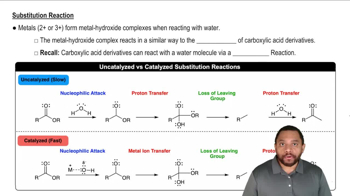
Metal Ion Catalysis: Water Activation Concept 2
Charge Interactions
Charge interactions are crucial for substrate binding in enzyme active sites. These interactions can include ionic bonds, where oppositely charged groups attract each other, and hydrogen bonds, which involve a hydrogen atom shared between electronegative atoms. In the case of IPP, the diphosphate group likely interacts with positively charged residues in the active site, stabilizing its binding and positioning for catalysis.
Recommended video:
Guided course
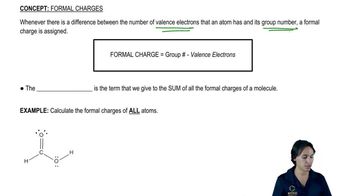
Calculating formal and net charge.
Diphosphate Group
A diphosphate group consists of two phosphate units linked together, carrying a negative charge due to the presence of oxygen atoms bonded to phosphorus. In biochemical contexts, such as enzyme-substrate interactions, the negative charge of diphosphate groups can form electrostatic interactions with positively charged amino acid residues, aiding in substrate stabilization and proper orientation for enzymatic activity.
Recommended video:
Guided course
Sequence Groups
Related Practice
Textbook Question
1341
views
Textbook Question
What is the expected product for the reaction of each of the following alkenes with (i) HBr and (ii) HCl?
(e)
851
views
Textbook Question
Which is the most likely transition state for the reactions shown? Explain your answer. [Note the difference in the size of the partial charges or partial unpaired electrons.]
990
views
Textbook Question
What is the expected product for the reaction of each of the following alkenes with (i) HBr and (ii) HCl?
(d)
1340
views
Textbook Question
Which would you expect to be more selective for carbocation formation, the electrophilic addition of HF or HBr to 2-methylbut-2-ene? Explain your answer.
1020
views
Textbook Question
Draw a mechanism for the acid-catalyzed conversion of DPP to IPP. How do you know that your mechanism is correct?
1195
views