Textbook Question
Imagine an electrophilic addition where the first step is exothermic. Which carbocation—2°, 3°, or neither—would you expect to form preferentially? Explain.
1341
views

 Mullins 1st EditionCh. 8 - Alkenes I: Properties and Electrophilic AdditionsProblem 31d
 Verified step by step guidance
 03:54
03:54
 05:39
05:39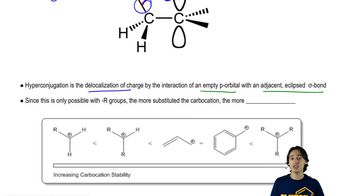 05:58
05:58Imagine an electrophilic addition where the first step is exothermic. Which carbocation—2°, 3°, or neither—would you expect to form preferentially? Explain.
Would you expect but-2-ene or 2-methylbut-2-ene to react more quickly with HBr?
What is the expected product for the reaction of each of the following alkenes with (i) HBr and (ii) HCl?
(e)
Provide an arrow-pushing mechanism that rationalizes the formation of each of the products you predicted in Assessment 8.31. Make sure your mechanism accounts for all products formed, including stereoisomers and regioisomers, where applicable.
For the enzyme isopentenyl pyrophosphate isomerase, IPP binds tightly as a result of interactions between the active site amino acid residues and the diphosphate of IPP. Without concerning yourself with the structure of amino acids, what charges might you expect to be present in the active site to hold IPP in place so that the enzymatic reactions can occur?
Draw a mechanism for the acid-catalyzed conversion of DPP to IPP. How do you know that your mechanism is correct?