Ch. 8 - Alkenes I: Properties and Electrophilic Additions
Mullins - Organic Chemistry: A Learner Centered Approach 1st Edition
Mullins1st EditionOrganic Chemistry: A Learner Centered ApproachISBN: 9780137566471Not the one you use?Change textbook
Chapter 7, Problem 32

Provide an arrow-pushing mechanism that rationalizes the formation of each of the products you predicted in Assessment 8.31. Make sure your mechanism accounts for all products formed, including stereoisomers and regioisomers, where applicable.

Verified step by step guidance
1
Identify the starting materials and the type of reaction taking place. Consider the functional groups involved and the reagents used in Assessment 8.31.
Determine the possible intermediates that can form during the reaction. Use your knowledge of reaction mechanisms to predict how electrons will move. This often involves identifying nucleophiles and electrophiles.
Draw the arrow-pushing mechanism for the formation of the first product. Start by showing the movement of electrons from the nucleophile to the electrophile, forming new bonds or breaking existing ones.
Consider stereochemistry and regioselectivity. For each product, analyze how the arrangement of atoms might lead to different stereoisomers or regioisomers. Use wedge and dash notation to indicate stereochemistry where applicable.
Repeat the arrow-pushing mechanism for each additional product, ensuring that all possible stereoisomers and regioisomers are accounted for. Compare the stability of each product to rationalize their formation.

Verified video answer for a similar problem:

This video solution was recommended by our tutors as helpful for the problem above.
Video duration:
3m
Was this helpful?

Key Concepts

Here are the essential concepts you must grasp in order to answer the question correctly.

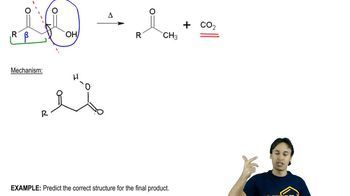
Arrow-Pushing Mechanism

Arrow-pushing is a technique used in organic chemistry to depict the movement of electrons during chemical reactions. It involves using curved arrows to show how electron pairs move from nucleophiles to electrophiles, helping to visualize the step-by-step transformation of reactants into products. Understanding this concept is crucial for predicting reaction outcomes and mechanisms.
Recommended video:
Guided course
04:32
General Mechanism

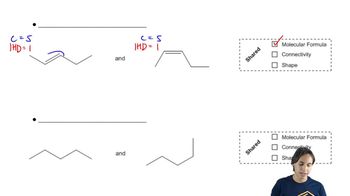
Stereoisomers

Stereoisomers are molecules with the same molecular formula and sequence of bonded atoms, but differ in the three-dimensional orientations of their atoms. This concept is essential for understanding how different spatial arrangements can lead to distinct chemical properties and reactivities, which must be considered when predicting products in a chemical reaction.
Recommended video:
Guided course
01:58
Determining when molecules are stereoisomers.

Regioisomers

Regioisomers are isomers that differ in the position of substituents or functional groups within a molecule. This concept is important for understanding how different positions can affect the stability and reactivity of molecules, influencing the formation of specific products in a chemical reaction. Recognizing regioisomer formation is key to accurately predicting reaction outcomes.