Textbook Question
The acid-catalyzed hydration we learned here in Chapter 8 is reversible:
(d) How might you shift the equilibrium to the right?
1402
views

 Mullins 1st EditionCh. 8 - Alkenes I: Properties and Electrophilic AdditionsProblem 77c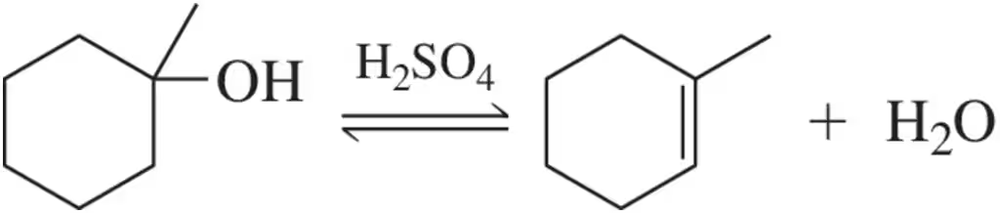
 Verified step by step guidance
 04:12
04:12
 03:06
03:06 02:19
02:19The acid-catalyzed hydration we learned here in Chapter 8 is reversible:
(d) How might you shift the equilibrium to the right?
The reaction of (E)-3-chlorohex-3-ene with HCl results in the selective formation of 3,3-dichlorohexane instead of 3,4-dichlorohexane. Explain this result.
The acid-catalyzed hydration we learned here in Chapter 8 is reversible.
(a) Propose a mechanism for the formation of an alkene from an alcohol.
North American termite soldiers, when encountering enemy insects, contract their mandibular muscles, expelling a mixture of chemicals that essentially trap their enemies in a glue-like substance. This weapon, built into the face of the termite, is called the fontanellar gun. It releases a mixture of pinene (62%), myrcene (27%), and limonene (11%). pinene myrcene limonene 62% 27% 11%
(a) Identify the isoprene units in pinene, myrcene, and limonene.
North American termite soldiers, when encountering enemy insects, contract their mandibular muscles, expelling a mixture of chemicals that essentially trap their enemies in a glue-like substance. This weapon, built into the face of the termite, is called the fontanellar gun. It releases a mixture of pinene (62%), myrcene (27%), and limonene (11%).
(b) Suggest an acid-catalyzed mechanism by which pinene could be produced from limonene.
The acid-catalyzed hydration we learned here in Chapter 8 is reversible:
(e) How might you shift the equilibrium to the left?