Ch. 8 - Alkenes I: Properties and Electrophilic Additions
Mullins - Organic Chemistry: A Learner Centered Approach 1st Edition
Mullins1st EditionOrganic Chemistry: A Learner Centered ApproachISBN: 9780137566471Not the one you use?Change textbook
Chapter 7, Problem 77a

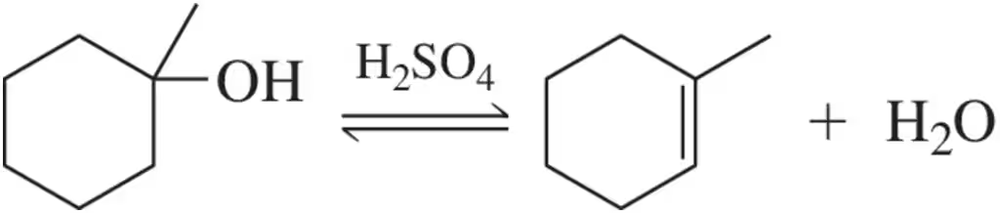
The acid-catalyzed hydration we learned here in Chapter 8 is reversible.
Chemical reaction diagram showing the dehydration of an alcohol to form an alkene, with sulfuric acid as a catalyst.
(a) Propose a mechanism for the formation of an alkene from an alcohol.

Verified step by step guidance
1
Step 1: Recognize that the acid-catalyzed dehydration of an alcohol to form an alkene is the reverse of the acid-catalyzed hydration of an alkene. This reaction typically occurs under acidic conditions and involves the removal of a water molecule.
Step 2: Protonation of the alcohol: In the presence of an acid (e.g., H₂SO₄ or H₃PO₄), the hydroxyl group (-OH) of the alcohol is protonated to form a better leaving group. This step increases the electrophilicity of the carbon attached to the hydroxyl group. The reaction can be represented as: R-OH+H+R-OH+
Step 3: Formation of the carbocation: The protonated alcohol undergoes elimination of water (H₂O), leaving behind a carbocation intermediate. This step is crucial and depends on the stability of the carbocation formed. The reaction can be represented as: R-OH+R-++HO
Step 4: Rearrangement (if necessary): If the initial carbocation is not the most stable form, a rearrangement (e.g., hydride shift or alkyl shift) may occur to form a more stable carbocation. This step is important for ensuring the formation of the most stable alkene product.
Step 5: Formation of the alkene: The carbocation undergoes deprotonation at an adjacent carbon atom, leading to the formation of a double bond (alkene). A base (often the conjugate base of the acid used, such as HSO₄⁻) abstracts a proton from the β-carbon, resulting in the formation of the alkene. The reaction can be represented as: R-+R=R+H+

Verified video answer for a similar problem:

This video solution was recommended by our tutors as helpful for the problem above.
Video duration:
7m
Was this helpful?

Key Concepts

Here are the essential concepts you must grasp in order to answer the question correctly.

Acid-Catalyzed Dehydration

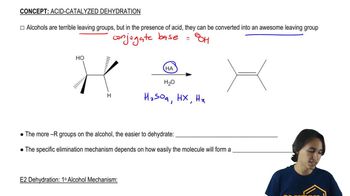
Acid-catalyzed dehydration is a reaction where an alcohol is converted into an alkene through the removal of a water molecule. This process typically involves protonation of the alcohol's hydroxyl group, making it a better leaving group, followed by the elimination of water and the formation of a double bond. Understanding this mechanism is crucial for proposing a detailed pathway for the transformation.
Recommended video:
Guided course
06:01
General features of acid-catalyzed dehydration.

Carbocation Stability

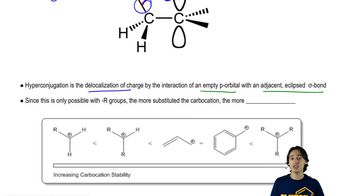
Carbocations are positively charged carbon species that play a key role in many organic reactions, including dehydration. The stability of a carbocation is influenced by its degree (primary, secondary, tertiary) and the presence of electron-donating groups. A more stable carbocation is more likely to form during the reaction, which affects the regioselectivity and outcome of the alkene formation.
Recommended video:
Guided course
05:58
Determining Carbocation Stability

Elimination Reactions (E1 and E2)

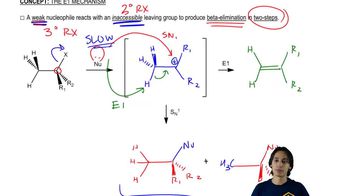
Elimination reactions, such as E1 and E2, describe the mechanisms by which alkenes are formed from alcohols. E1 involves a two-step mechanism where a carbocation intermediate is formed, while E2 is a concerted mechanism that occurs in a single step. Understanding these pathways helps in predicting the conditions and products of the dehydration process.
Recommended video:
Guided course
03:32
Understanding the properties of E1.
Related Practice
Textbook Question

The acid-catalyzed hydration we learned here in Chapter 8 is reversible:

(d) How might you shift the equilibrium to the right?

1402
views

Textbook Question

North American termite soldiers, when encountering enemy insects, contract their mandibular muscles, expelling a mixture of chemicals that essentially trap their enemies in a glue-like substance. This weapon, built into the face of the termite, is called the fontanellar gun. It releases a mixture of pinene (62%), myrcene (27%), and limonene (11%). pinene myrcene limonene 62% 27% 11%

(a) Identify the isoprene units in pinene, myrcene, and limonene.

1068
views
Textbook Question

North American termite soldiers, when encountering enemy insects, contract their mandibular muscles, expelling a mixture of chemicals that essentially trap their enemies in a glue-like substance. This weapon, built into the face of the termite, is called the fontanellar gun. It releases a mixture of pinene (62%), myrcene (27%), and limonene (11%).

(b) Suggest an acid-catalyzed mechanism by which pinene could be produced from limonene.

793
views
Textbook Question

The acid-catalyzed hydration we learned here in Chapter 8 is reversible:

(c) Which side of the reaction would be favored by running the reaction at high temperatures?

886
views
Textbook Question

The acid-catalyzed hydration we learned here in Chapter 8 is reversible:

(e) How might you shift the equilibrium to the left?

1206
views
Textbook Question

The formation of five-membered ring ethers is an important goal in synthetic organic chemistry because tetrahydrofurans are contained within a number of antitumor natural products. Toward that end, a one-pot synthesis of a bis-THF containing compound was developed (Eur. J. Org. Chem. 2010, 6263–6268). Suggest a mechanism for this transformation.

1067
views