Ch. 9 - Alkenes II: Oxidation and Reduction
Mullins - Organic Chemistry: A Learner Centered Approach 1st Edition
Mullins1st EditionOrganic Chemistry: A Learner Centered ApproachISBN: 9780137566471Not the one you use?Change textbook
Chapter 8, Problem 40c

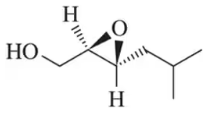
Identify the alkene that would react with Ti(OiPr)₄, (+) -diethyltartrate, and t-butylhydroperoxide to give the following chiral, nonracemic epoxides.
(c)

Verified step by step guidance
1
Recognize that the reagents Ti(OiPr)₄, (+)-diethyltartrate, and t-butylhydroperoxide are used in the Sharpless epoxidation, which is a method for the enantioselective epoxidation of allylic alcohols.
Identify the structure of the given epoxide. The epoxide shown has a chiral center and is nonracemic, indicating that it was formed through an enantioselective process.
Determine the configuration of the chiral center in the epoxide. The stereochemistry of the epoxide will be determined by the chirality of the starting allylic alcohol and the enantioselectivity of the Sharpless epoxidation.
Consider the structure of the starting alkene. The starting alkene should be an allylic alcohol, which means it should have a hydroxyl group (OH) adjacent to the double bond.
Propose the structure of the alkene that would lead to the given epoxide. The alkene should have the same carbon skeleton as the epoxide, with the double bond positioned such that the hydroxyl group is allylic to it.

Verified video answer for a similar problem:

This video solution was recommended by our tutors as helpful for the problem above.
Was this helpful?

Key Concepts

Here are the essential concepts you must grasp in order to answer the question correctly.

Alkene Reactivity

Alkenes are hydrocarbons that contain at least one carbon-carbon double bond. Their reactivity is primarily due to the presence of this double bond, which can undergo various reactions, including electrophilic additions. Understanding the structure and substitution pattern of the alkene is crucial for predicting its reactivity with reagents like Ti(OiPr)₄ and t-butylhydroperoxide.
Recommended video:
2:09
Alkene Metathesis Concept 1

Epoxidation

Epoxidation is a chemical reaction that converts alkenes into epoxides, which are three-membered cyclic ethers. This reaction can be facilitated by various oxidizing agents, including peroxides. The stereochemistry of the epoxide formed is influenced by the substituents on the alkene and the specific conditions of the reaction, which is essential for producing chiral, nonracemic products.
Recommended video:
Guided course
02:19
General properties of epoxidation.

Chirality and Nonracemic Mixtures

Chirality refers to the property of a molecule that makes it non-superimposable on its mirror image, leading to the existence of enantiomers. Nonracemic mixtures contain an unequal proportion of these enantiomers, resulting in optical activity. In the context of the question, understanding how the reaction conditions and starting materials influence chirality is vital for predicting the outcome of the epoxidation process.
Recommended video:
Guided course
05:10
What is chirality?