
Textbook Question
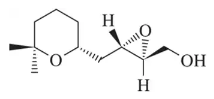
Identify the alkene that would react with Ti(OiPr)₄, (+) -diethyltartrate, and t-butylhydroperoxide to give the following chiral, nonracemic epoxides.
(c)
602
views

 Verified step by step guidance
 02:19
02:19
 1:21
1:21 2:31
2:31Identify the alkene that would react with Ti(OiPr)₄, (+) -diethyltartrate, and t-butylhydroperoxide to give the following chiral, nonracemic epoxides.
(c)
Conjugated dienes, molecules containing two alkenes separated by one single bond, are discussed in detail in Chapter 21.
(b) How might you account for this difference in stability?
Calculate the oxidation number for the indicated carbons.
(a)
The chiral catalyst (R)-BINAP(COD)RhOTf was used in a hydrogenation reaction as part of the synthesis of fragment C of indinavir. Using the same alkene, predict the product that would be obtained if (S)-BINAP(COD)RhOTf were used instead.
Identify the alkene that would react with Ti(OiPr)₄, (+) -diethyltartrate, and t-butylhydroperoxide to give the following chiral, nonracemic epoxides.
(a)
Questions (a)–(d) all refer to the following reaction, which has been engineered to produce one enantiomer to the exclusion of the other.
(c) Suppose the difference in activation energy is 1.6 kcal/mol. At what temperature would you produce C in 99% ee?