
Fluoxetine, an antidepressant, is better known as Prozac®. Suggest reagents that could be used to make the indicated C–O bond of fluoxetine. [Note that CF3, an electron-withdrawing group, is para to where the new bond will be formed.]
Ch. 23 - Benzene I: Aromatic Stability and Substitution Reactions

Mullins1st EditionOrganic Chemistry: A Learner Centered ApproachISBN: 9780137566471Not the one you use?Change textbook
All textbooks
Mullins 1st Edition
Ch. 23 - Benzene I: Aromatic Stability and Substitution Reactions
Problem 86
Mullins 1st Edition
Ch. 23 - Benzene I: Aromatic Stability and Substitution Reactions
Problem 86Chapter 22, Problem 86
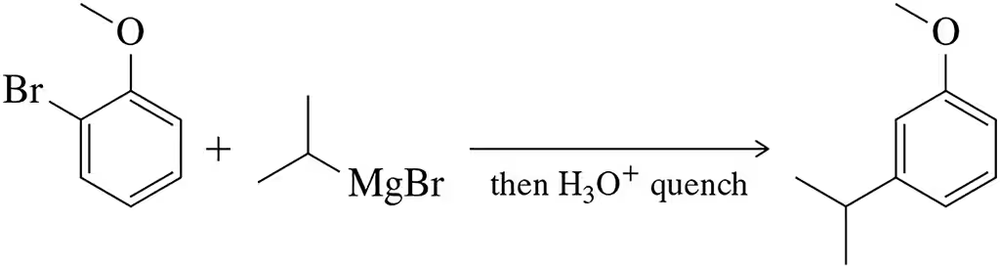
Addition by the benzyne mechanism is not usually regioselective. Explain the fact that the reaction shown is highly regioselective for the product shown.

Verified step by step guidance1
Identify the starting materials: The reaction involves a brominated anisole and an isopropyl Grignard reagent (isopropylmagnesium bromide).
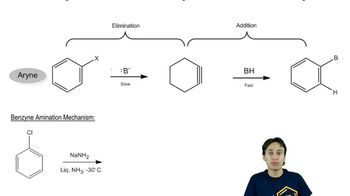
Understand the benzyne mechanism: The reaction likely proceeds through a benzyne intermediate, which is formed by the elimination of the bromine atom and a hydrogen atom from the aromatic ring, generating a highly reactive triple-bonded species.
Consider the regioselectivity: The benzyne intermediate can react with the Grignard reagent at two possible positions, but the presence of the methoxy group (OCH3) on the aromatic ring influences the regioselectivity.
Analyze the electronic effects: The methoxy group is an electron-donating group through resonance, which stabilizes the negative charge at the ortho and para positions relative to itself. This makes the ortho position more favorable for nucleophilic attack by the Grignard reagent.
Conclude the regioselectivity: The reaction is regioselective because the Grignard reagent preferentially attacks the ortho position relative to the methoxy group, leading to the observed product with the isopropyl group adjacent to the methoxy group.

Verified video answer for a similar problem:
This video solution was recommended by our tutors as helpful for the problem above.
Was this helpful?
Key Concepts
Here are the essential concepts you must grasp in order to answer the question correctly.
Benzyne Mechanism
The benzyne mechanism involves the formation of a highly reactive intermediate known as benzyne, which is generated by the elimination of a leaving group from a substituted aromatic compound. This intermediate can undergo nucleophilic addition reactions, but these reactions are typically not regioselective due to the symmetrical nature of the benzyne structure, allowing for multiple possible products.
Recommended video:
Guided course
General Mechanism
Regioselectivity
Regioselectivity refers to the preference of a chemical reaction to yield one structural isomer over others when multiple products are possible. In the context of the reaction shown, the regioselectivity is influenced by the stability of the intermediates formed during the reaction, as well as steric and electronic factors that favor the formation of a specific product.
Recommended video:
Guided course
Heck Reaction
Nucleophilic Addition
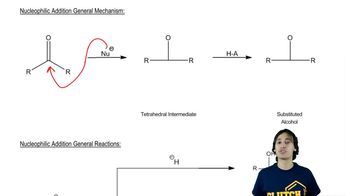
Nucleophilic addition is a fundamental reaction in organic chemistry where a nucleophile attacks an electrophilic center, leading to the formation of a new bond. In the reaction depicted, the nucleophile (MgBr) adds to the electrophilic carbon of the benzyne intermediate, resulting in a regioselective product due to the specific orientation and electronic effects of the substituents on the aromatic ring.
Recommended video:
Guided course
Nucleophilic Addition
Related Practice
Textbook Question
568
views
Textbook Question
Suggest a synthesis of the molecule on the right beginning with the molecules on the left.
919
views
Textbook Question
How might you use 13C NMR spectroscopy to differentiate between the possible ortho, meta, and para products of the electrophilic aromatic substitution reaction shown?
1493
views
Textbook Question
Suggest an arrow-pushing mechanism of the following rearrangement.
919
views
Textbook Question
Acetohexamide is used to treat type 2 diabetes that cannot be well controlled by diet alone. Fill in the blanks of the synthetic scheme used to synthesize acetohexamide. [Hints have been provided below each step.]
461
views