Ch. 22 - Conjugated Systems II: Pericyclic Reactions
Mullins - Organic Chemistry: A Learner Centered Approach 1st Edition
Mullins1st EditionOrganic Chemistry: A Learner Centered ApproachISBN: 9780137566471Not the one you use?Change textbook
Chapter 21, Problem 55

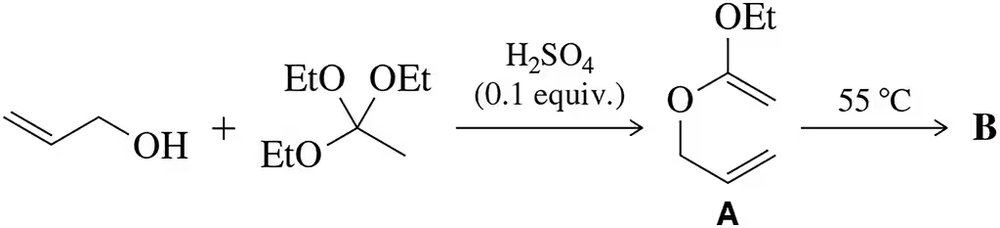
The Johnson–Claisen reaction is a variant of the Claisen reaction studied in this chapter. (a) Suggest a mechanism for the first step. (b) Predict the product (B) that would result from heating intermediate A.
Chemical reaction diagram showing reactants, intermediate A, and product B with conditions for the Johnson–Claisen reaction.

Verified step by step guidance
1
The Johnson–Claisen rearrangement involves the conversion of an allylic alcohol to an allylic ester. In the first step, the allylic alcohol reacts with the orthoester in the presence of a catalytic amount of acid (H2SO4) to form an intermediate hemiacetal.
The acid catalyzes the formation of the hemiacetal by protonating the orthoester, making it more electrophilic and susceptible to nucleophilic attack by the alcohol.
Once the hemiacetal is formed, it undergoes a rearrangement. The allylic group migrates to the oxygen atom, forming a new carbon-oxygen bond and resulting in the formation of an enol ether intermediate (A).
Upon heating, the enol ether intermediate (A) undergoes a [3,3]-sigmatropic rearrangement, which is characteristic of the Claisen rearrangement. This rearrangement involves the migration of the allylic group and the formation of a new carbon-carbon bond.
The final product (B) is an allylic ester, which is formed after the rearrangement and subsequent tautomerization of the enol ether intermediate.

Verified video answer for a similar problem:

This video solution was recommended by our tutors as helpful for the problem above.
Was this helpful?

Key Concepts

Here are the essential concepts you must grasp in order to answer the question correctly.

Johnson–Claisen Reaction

The Johnson–Claisen reaction is a variant of the Claisen rearrangement, involving the conversion of allylic alcohols into γ,δ-unsaturated carbonyl compounds. This reaction typically involves the use of an orthoester and an acid catalyst, leading to the formation of an intermediate enol ether, which rearranges to form the final product. Understanding this reaction is crucial for predicting the transformation of intermediate A to product B.
Recommended video:
Guided course
02:10
Claisen-Schmidt Reaction

Mechanism of the Johnson–Claisen Reaction

The mechanism begins with the protonation of the orthoester by the acid catalyst, followed by nucleophilic attack by the allylic alcohol, leading to the formation of an enol ether intermediate. This intermediate undergoes a [3,3]-sigmatropic rearrangement, resulting in the formation of a γ,δ-unsaturated carbonyl compound. Recognizing these steps helps in suggesting the mechanism for the first step of the reaction.
Recommended video:
Guided course
02:10
Claisen-Schmidt Reaction

Sigmatropic Rearrangement

A sigmatropic rearrangement is a pericyclic reaction where a sigma bond adjacent to one or more pi systems migrates across the pi system. In the Johnson–Claisen reaction, a [3,3]-sigmatropic rearrangement occurs, where the enol ether intermediate rearranges to form a new carbon-carbon bond, leading to the formation of the final product. This concept is essential for predicting the structure of product B from intermediate A.
Recommended video:
Guided course
03:20
Nomenclature of Sigmatropic Shifts