Ch. 14 - Structural Identification I: Infrared Spectroscopy and Mass Spectrometry
Mullins - Organic Chemistry: A Learner Centered Approach 1st Edition
Mullins1st EditionOrganic Chemistry: A Learner Centered ApproachISBN: 9780137566471Not the one you use?Change textbook
Chapter 13, Problem 35

Besides the molecular mass, how do you know that the fragment that gives rise to the peak at m/z 111 in the mass spectrum for 1-bromo-4-chlorobenzene contains only chlorine?
<IMAGE>

Verified step by step guidance
1
Understand that the mass spectrum provides information about the fragments of a molecule based on their mass-to-charge ratio (m/z). Each peak corresponds to a fragment of the original molecule.
Recognize that 1-bromo-4-chlorobenzene contains both bromine and chlorine atoms, which can influence the mass spectrum due to their isotopic patterns.
Recall that chlorine has two common isotopes: Cl-35 and Cl-37. The presence of these isotopes can create a characteristic pattern in the mass spectrum, typically a peak and a smaller peak two units higher (due to Cl-37).
Consider the isotopic pattern of bromine, which also has two isotopes: Br-79 and Br-81. This results in a distinct pattern with peaks separated by two m/z units, similar to chlorine but with different relative intensities.
Analyze the peak at m/z 111. If this peak corresponds to a fragment containing only chlorine, it should exhibit the characteristic chlorine isotopic pattern without the additional pattern that would be expected if bromine were present. This can be confirmed by the absence of a corresponding peak that would indicate the presence of bromine isotopes.

Verified video answer for a similar problem:

This video solution was recommended by our tutors as helpful for the problem above.
Was this helpful?

Key Concepts

Here are the essential concepts you must grasp in order to answer the question correctly.

Mass Spectrometry

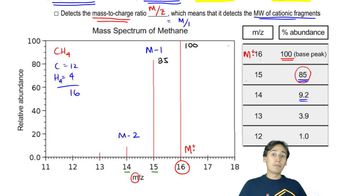
Mass spectrometry is an analytical technique used to measure the mass-to-charge ratio (m/z) of ions. It helps identify the composition of a sample by generating a mass spectrum, which displays the mass of fragments. Understanding how to interpret these spectra is crucial for identifying molecular fragments and their compositions.
Recommended video:
Guided course
01:25
How to Read a Mass Spectrum

Isotopic Patterns

Isotopic patterns arise from the presence of isotopes, which are atoms of the same element with different numbers of neutrons. Chlorine, for example, has two common isotopes, Cl-35 and Cl-37, which create a distinct pattern in mass spectra. Recognizing these patterns helps determine the presence of specific elements in a fragment.
Recommended video:
Guided course
08:06
Common Splitting Patterns

Fragmentation in Mass Spectrometry

Fragmentation occurs when a molecule breaks into smaller pieces during mass spectrometry. Each fragment corresponds to a peak in the mass spectrum. Understanding the typical fragmentation patterns of compounds, such as the loss of halogens, aids in deducing which elements are present in a specific fragment.
Recommended video:
Guided course
01:25
How to Read a Mass Spectrum