Ch. 14 - Structural Identification I: Infrared Spectroscopy and Mass Spectrometry
Mullins - Organic Chemistry: A Learner Centered Approach 1st Edition
Mullins1st EditionOrganic Chemistry: A Learner Centered ApproachISBN: 9780137566471Not the one you use?Change textbook
Chapter 13, Problem 39

Suggest three ways that the following tertiary amine can fragment by α-cleavage. At which m/z would you expect to see peaks corresponding to these fragments?
Chemical structure of a tertiary amine with a branched chain and an NH2 group attached to a central carbon.

Verified step by step guidance
1
Identify the structure of the tertiary amine. A tertiary amine has three alkyl groups attached to the nitrogen atom. Determine the specific alkyl groups present in the given amine structure.
Understand α-cleavage: In mass spectrometry, α-cleavage refers to the breaking of the bond adjacent to the nitrogen atom in amines. This results in the formation of a radical and a cation. Identify the bonds adjacent to the nitrogen atom that can undergo cleavage.
For each α-cleavage possibility, draw the structure of the resulting fragments. This involves breaking the bond between the nitrogen and the adjacent carbon atom, leading to the formation of a nitrogen-centered radical and a carbon-centered cation.
Calculate the m/z (mass-to-charge ratio) for each fragment. The m/z value is determined by the mass of the fragment divided by its charge. Since the fragments are typically singly charged, the m/z value is equal to the mass of the fragment.
Predict the m/z peaks: Based on the calculated m/z values for each fragment, predict the m/z peaks you would expect to see in the mass spectrum. These peaks correspond to the fragments formed by α-cleavage.

Verified video answer for a similar problem:

This video solution was recommended by our tutors as helpful for the problem above.
Video duration:
6m
Was this helpful?

Key Concepts

Here are the essential concepts you must grasp in order to answer the question correctly.

Tertiary Amine Structure

A tertiary amine is an organic compound where a nitrogen atom is bonded to three alkyl or aryl groups. Understanding its structure is crucial for predicting fragmentation patterns, as the nitrogen's lone pair can influence bond cleavage and stability of resulting fragments.
Recommended video:
2:07
Tertiary Protein Structure Concept 1

α-Cleavage in Mass Spectrometry

α-Cleavage refers to the breaking of a bond adjacent to a functional group, such as the nitrogen in amines. This process is significant in mass spectrometry as it helps identify the structure of the compound by generating characteristic fragments, which can be detected and analyzed based on their mass-to-charge ratio (m/z).
Recommended video:
Guided course
01:25
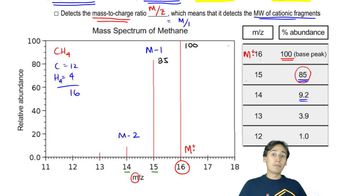
How to Read a Mass Spectrum

Mass-to-Charge Ratio (m/z)

The mass-to-charge ratio (m/z) is a key parameter in mass spectrometry, representing the mass of a fragment divided by its charge. Peaks in a mass spectrum correspond to specific m/z values, allowing for the identification of fragments resulting from α-cleavage, and providing insights into the molecular structure of the original compound.
Recommended video:
Guided course
10:48
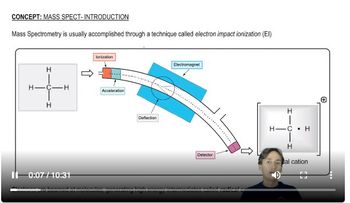
Equipment and Theory