Ch. 14 - Structural Identification I: Infrared Spectroscopy and Mass Spectrometry
Mullins - Organic Chemistry: A Learner Centered Approach 1st Edition
Mullins1st EditionOrganic Chemistry: A Learner Centered ApproachISBN: 9780137566471Not the one you use?Change textbook
Chapter 13, Problem 41

The base peak in Figure 14.51 has m/z 45. Suggest a molecular formula and a structure for this fragment.
<IMAGE>

Verified step by step guidance
1
Understand that the base peak in a mass spectrum represents the most abundant ion, and its m/z value is crucial for deducing the structure of the fragment.
The m/z value of 45 suggests a fragment with a molecular weight of 45. Consider common organic fragments that could have this mass.
Calculate possible molecular formulas that sum to a molecular weight of 45. For example, consider C3H9N (molecular weight: 3*12 + 9*1 + 14 = 45) or C2H5O (molecular weight: 2*12 + 5*1 + 16 = 45).
Evaluate the chemical plausibility of each formula by considering typical fragmentation patterns in mass spectrometry. For instance, C2H5O could represent an ethoxy group, which is a common fragment.
Propose a structure for the fragment based on the plausible molecular formula. For example, if C2H5O is considered, the structure could be an ethoxy group (CH3CH2O).

Verified video answer for a similar problem:

This video solution was recommended by our tutors as helpful for the problem above.
Was this helpful?

Key Concepts

Here are the essential concepts you must grasp in order to answer the question correctly.

Mass Spectrometry

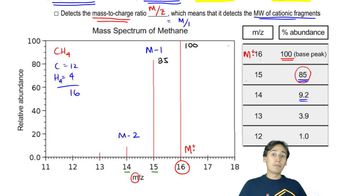
Mass spectrometry is an analytical technique used to measure the mass-to-charge ratio (m/z) of ions. It helps identify the composition of a sample by analyzing the mass of its fragments. The base peak represents the most abundant ion, providing clues about the structure of the molecule.
Recommended video:
Guided course
01:25
How to Read a Mass Spectrum

Fragmentation Patterns

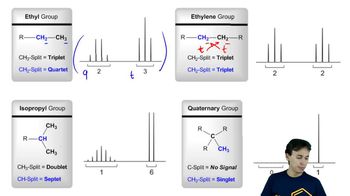
Fragmentation patterns in mass spectrometry refer to the way molecules break apart into smaller ions. Understanding these patterns is crucial for deducing the structure of the original molecule. The m/z value of a fragment can suggest possible molecular formulas and structural components.
Recommended video:
Guided course
08:06
Common Splitting Patterns

Molecular Formula Determination

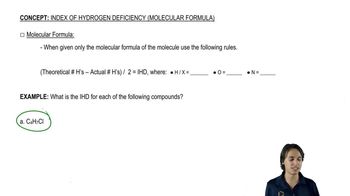
Determining a molecular formula involves calculating the possible combinations of atoms that match the observed m/z value. This requires knowledge of atomic masses and common molecular fragments. For m/z 45, potential fragments could include C3H9N or C2H5O, guiding the identification of the structure.
Recommended video:
Guided course
02:17
How to use IHD with molecular formula.