Ch. 27 - Carbohydrates, Nucleic Acids, and Lipids
Mullins - Organic Chemistry: A Learner Centered Approach 1st Edition
Mullins1st EditionOrganic Chemistry: A Learner Centered ApproachISBN: 9780137566471Not the one you use?Change textbook
Chapter 26, Problem 25

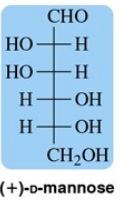
Draw the α- and β-anomers of d-mannofuranose. [The structure of mannose is in Figure 27.11.]
Structural representation of (+)-D-mannose, showing its hydroxyl groups and aldehyde functional group.

Verified step by step guidance
1
Identify the structure of D-mannose from the image provided. D-mannose is an aldohexose, which means it has an aldehyde group (CHO) at the top and six carbon atoms in total.
Convert the linear form of D-mannose into its furanose form. Furanoses are five-membered rings, so you will need to form a ring by connecting the C-1 aldehyde group to the hydroxyl group on C-4.
Draw the five-membered ring structure. The oxygen from the hydroxyl group on C-4 will become part of the ring, and the C-1 carbon will become an anomeric carbon.
Determine the configuration of the α-anomer. In the α-anomer, the hydroxyl group on the anomeric carbon (C-1) is trans to the CH2OH group at C-5, meaning they are on opposite sides of the ring.
Determine the configuration of the β-anomer. In the β-anomer, the hydroxyl group on the anomeric carbon (C-1) is cis to the CH2OH group at C-5, meaning they are on the same side of the ring.

Verified video answer for a similar problem:

This video solution was recommended by our tutors as helpful for the problem above.
Video duration:
3m
Was this helpful?

Key Concepts

Here are the essential concepts you must grasp in order to answer the question correctly.

Anomeric Carbon

The anomeric carbon is the carbon atom in a sugar molecule that becomes a new stereocenter when the sugar cyclizes. In the case of mannofuranose, this is the carbon that forms the hemiacetal linkage, allowing for the formation of α- and β-anomers, which differ in the orientation of the hydroxyl group attached to this carbon.
Recommended video:
Guided course
02:12
Carbonation of Grignard Reagents

Furanose Ring

A furanose ring is a five-membered ring structure formed when a sugar molecule cyclizes. D-mannofuranose is derived from D-mannose, which forms a furanose ring by the reaction of the aldehyde group with one of the hydroxyl groups, typically the one on the fourth carbon, resulting in a cyclic structure that resembles furan.
Recommended video:
Guided course
05:14
Ring Expansion

α- and β-Anomers

Anomers are isomers of cyclic sugars that differ in the configuration around the anomeric carbon. In α-anomers, the hydroxyl group on the anomeric carbon is trans to the CH2OH group, while in β-anomers, it is cis. This distinction is crucial for understanding the structural differences between α- and β-D-mannofuranose.
Recommended video:
Guided course
02:20
Unique β-carbons and possible products