Ch. 27 - Carbohydrates, Nucleic Acids, and Lipids
Mullins - Organic Chemistry: A Learner Centered Approach 1st Edition
Mullins1st EditionOrganic Chemistry: A Learner Centered ApproachISBN: 9780137566471Not the one you use?Change textbook
Chapter 26, Problem 23

Suggest a mechanism by which α-d-glucopyranose is converted to β-d-glucopyranose in base. [See Figure 27.18.]
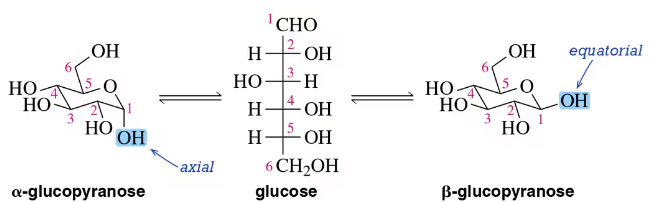
Diagram illustrating the conversion of α-d-glucopyranose to β-d-glucopyranose, highlighting axial and equatorial positions of hydroxyl groups.

Verified step by step guidance
1
Identify the starting material, α-d-glucopyranose, which has the hydroxyl group at the anomeric carbon (C1) in the axial position.
Recognize that the conversion to β-d-glucopyranose involves the change of the hydroxyl group at the anomeric carbon from axial to equatorial position.
Understand that in basic conditions, the hydroxyl group can be deprotonated, forming an alkoxide ion, which is a good nucleophile.
Consider the formation of an open-chain aldehyde intermediate through the cleavage of the hemiacetal linkage, allowing rotation around the C1-C2 bond.
Envision the reformation of the cyclic structure, where the nucleophilic attack by the alkoxide ion occurs from the opposite side, leading to the equatorial position of the hydroxyl group in β-d-glucopyranose.

Verified video answer for a similar problem:

This video solution was recommended by our tutors as helpful for the problem above.
Video duration:
3m
Was this helpful?

Key Concepts

Here are the essential concepts you must grasp in order to answer the question correctly.

Anomeric Carbon

The anomeric carbon is the carbon atom in a sugar molecule that was originally the carbonyl carbon in the open-chain form. In cyclic forms of glucose, it is the carbon bonded to two oxygen atoms. The configuration of the hydroxyl group attached to this carbon determines whether the sugar is in the alpha (α) or beta (β) form, as seen in α-d-glucopyranose and β-d-glucopyranose.
Recommended video:
Guided course
02:12
Carbonation of Grignard Reagents

Mutarotation

Mutarotation is the process by which an α-anomer of a sugar converts to a β-anomer (or vice versa) in solution, resulting in a change in optical rotation. This occurs through the opening of the cyclic form to the linear form and subsequent reclosure, allowing the hydroxyl group on the anomeric carbon to switch positions. In basic conditions, this process is facilitated, leading to the interconversion of α-d-glucopyranose and β-d-glucopyranose.
Recommended video:

Axial and Equatorial Positions

In cyclic sugar structures, substituents can occupy axial or equatorial positions. Axial positions are perpendicular to the plane of the ring, while equatorial positions are roughly in the plane of the ring. The stability of a sugar molecule can be influenced by these positions, as equatorial positions generally offer less steric hindrance. In the conversion from α-d-glucopyranose to β-d-glucopyranose, the hydroxyl group at the anomeric carbon changes from an axial to an equatorial position, affecting the molecule's stability and reactivity.
Recommended video:
Guided course
04:02
Equatorial Preference