Ch. 27 - Carbohydrates, Nucleic Acids, and Lipids
Mullins - Organic Chemistry: A Learner Centered Approach 1st Edition
Mullins1st EditionOrganic Chemistry: A Learner Centered ApproachISBN: 9780137566471Not the one you use?Change textbook
Chapter 26, Problem 26b

Draw the structure that corresponds to the given name.
(b) Benzyl α-d-gulopyranoside

Verified step by step guidance
1
Start by identifying the core structure: α-D-gulopyranoside. Gulopyranoside is a sugar molecule, specifically a pyranose form of gulose. The 'α' designation indicates the orientation of the hydroxyl group at the anomeric carbon (C1) is axial (downward in the Haworth projection).
Draw the pyranose ring: A six-membered ring consisting of five carbon atoms and one oxygen atom. Label the carbons from C1 to C6, starting from the anomeric carbon (C1) next to the oxygen.
Add the hydroxyl groups: For D-gulose, the hydroxyl groups are positioned as follows: C2 - equatorial, C3 - equatorial, C4 - axial, C5 - equatorial. Ensure the hydroxyl group at C1 is axial, as indicated by 'α'.
Attach the benzyl group: Benzyl refers to a phenyl group (C6H5) attached to a CH2 group. Connect the CH2 group to the oxygen atom of the anomeric carbon (C1) of the gulopyranoside, forming the glycosidic bond.
Verify the stereochemistry: Double-check the orientation of each hydroxyl group and the benzyl group to ensure the structure accurately represents benzyl α-D-gulopyranoside.

Verified video answer for a similar problem:

This video solution was recommended by our tutors as helpful for the problem above.
Video duration:
2m
Was this helpful?

Key Concepts

Here are the essential concepts you must grasp in order to answer the question correctly.

Benzyl Group

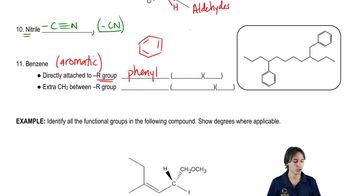
The benzyl group is a common substituent in organic chemistry, consisting of a benzene ring attached to a CH2 group. It is often used to protect alcohols and amines during chemical reactions. In the context of naming, 'benzyl' indicates the presence of this group attached to another functional group or molecule.
Recommended video:
Guided course
03:14
The difference between phenyl and benzyl groups.

Pyranose Ring

A pyranose ring is a six-membered ring structure that includes five carbon atoms and one oxygen atom, resembling the structure of pyran. In carbohydrates, pyranose forms are common, and they result from the cyclization of aldoses or ketoses. Understanding pyranose structures is crucial for identifying sugar configurations and their derivatives.
Recommended video:
Guided course
05:14
Ring Expansion

α-Anomeric Configuration

The α-anomeric configuration refers to the orientation of the hydroxyl group attached to the anomeric carbon in a cyclic sugar. In the α-configuration, the hydroxyl group is on the opposite side of the ring compared to the CH2OH group. This configuration is important for distinguishing between different sugar isomers and understanding their reactivity and interactions.
Recommended video:
Guided course
02:14
The Electron Configuration