Ch. 4 - Acids and Bases: Electron Flow
Mullins - Organic Chemistry: A Learner Centered Approach 1st Edition
Mullins1st EditionOrganic Chemistry: A Learner Centered ApproachISBN: 9780137566471Not the one you use?Change textbook
Chapter 3, Problem 19

Acid–base reactions are reversible. Show a mechanism for the reverse of the reactions in Assessment 4.18.

Verified step by step guidance
1
Identify the acid and base in the forward reaction. Recall that the acid donates a proton (H⁺), and the base accepts a proton. In the reverse reaction, the roles of the conjugate acid and conjugate base are reversed.
Draw the conjugate acid and conjugate base formed in the forward reaction. These will act as the base and acid, respectively, in the reverse reaction.
Use curved arrows to show the movement of electrons in the reverse reaction. Specifically, show the lone pair of electrons on the conjugate base attacking the proton (H⁺) on the conjugate acid, forming a new bond.
Indicate the breaking of the bond between the proton (H⁺) and the conjugate acid. Use a curved arrow to show the electrons from this bond returning to the atom that was bonded to the proton.
Verify that the reverse reaction regenerates the original acid and base from the forward reaction. Ensure that all charges and lone pairs are correctly accounted for in the mechanism.

Verified video answer for a similar problem:

This video solution was recommended by our tutors as helpful for the problem above.
Was this helpful?

Key Concepts

Here are the essential concepts you must grasp in order to answer the question correctly.

Acid-Base Reactions

Acid-base reactions involve the transfer of protons (H+) between reactants. An acid donates a proton, while a base accepts it. These reactions can be classified as strong or weak, depending on the extent of ionization in solution. Understanding the nature of the acids and bases involved is crucial for predicting the direction of the reaction.
Recommended video:
Guided course
02:49
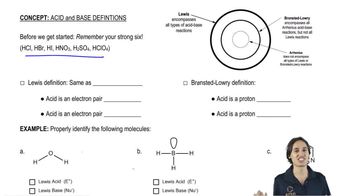
The Lewis definition of acids and bases.

Reversibility of Reactions

Reversible reactions can proceed in both forward and reverse directions, reaching a state of equilibrium. In acid-base reactions, this means that the products can react to regenerate the original reactants. The position of equilibrium is influenced by factors such as concentration, temperature, and the strength of the acids and bases involved.
Recommended video:
Guided course
11:50
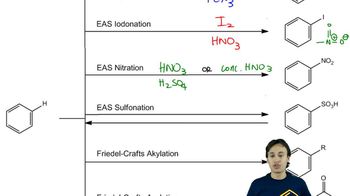
EAS Reactions Overview

Reaction Mechanism

A reaction mechanism outlines the step-by-step sequence of elementary reactions that occur during a chemical transformation. For acid-base reactions, this includes the proton transfer process and the formation of intermediates. Understanding the mechanism is essential for predicting the behavior of the reaction under different conditions and for illustrating the reverse process effectively.
Recommended video:
Guided course
02:16
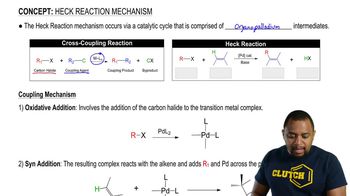
Heck Reaction Mechanism