Ch. 4 - Acids and Bases: Electron Flow
Mullins - Organic Chemistry: A Learner Centered Approach 1st Edition
Mullins1st EditionOrganic Chemistry: A Learner Centered ApproachISBN: 9780137566471Not the one you use?Change textbook
Chapter 3, Problem 20a(iv,v)

In the following reactions,
(iv) provide an arrow-pushing mechanism of the proton transfer that will occur, and
(v) predict the product of the reactions. [You'll need to provide the lone pairs here.]
(a) Chemical reaction showing an alkyne reacting with hydrobromic acid, indicating acid-base interaction.

Verified step by step guidance
1
Step 1: Analyze the reactants. The molecule on the left is a cyanide ion (N≡C⁻), which has a negative charge on the carbon atom. The molecule on the right is hydrochloric acid (HCl), a strong acid that can donate a proton (H⁺).
Step 2: Identify the nucleophile and electrophile. The cyanide ion acts as the nucleophile because the negatively charged carbon has lone pairs of electrons that can attack an electrophile. HCl acts as the electrophile because the hydrogen atom is partially positive and can accept electrons.
Step 3: Draw the arrow-pushing mechanism. The lone pair of electrons on the carbon atom of the cyanide ion will attack the hydrogen atom of HCl, forming a bond between the carbon and hydrogen. Simultaneously, the bond between hydrogen and chlorine will break, transferring the electrons to chlorine and forming a chloride ion (Cl⁻).
Step 4: Represent the lone pairs. After the proton transfer, the cyanide ion becomes neutral, forming hydrogen cyanide (HC≡N). The chloride ion (Cl⁻) will have three lone pairs of electrons.
Step 5: Predict the product. The final product of the reaction is hydrogen cyanide (HC≡N) and a chloride ion (Cl⁻). Ensure that all lone pairs are correctly represented in the product structure.

Verified video answer for a similar problem:

This video solution was recommended by our tutors as helpful for the problem above.
Video duration:
1m
Was this helpful?

Key Concepts

Here are the essential concepts you must grasp in order to answer the question correctly.

Proton Transfer Mechanism

Proton transfer mechanisms involve the movement of a proton (H+) from one molecule to another, typically facilitated by the presence of a base or an acid. In this context, the nucleophile (the species with a lone pair) will attack the proton of HCl, leading to the formation of a new bond. Understanding this mechanism is crucial for predicting the products of acid-base reactions.
Recommended video:
3:05
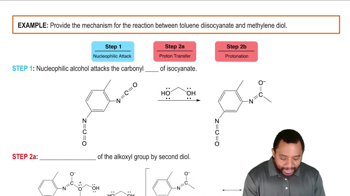
Polyurethane Mechanism Example 1

Nucleophiles and Electrophiles

Nucleophiles are species that donate an electron pair to form a chemical bond, while electrophiles are electron-deficient species that accept electron pairs. In the given reaction, the nucleophile is the cyanide ion (C≡N-), which will attack the electrophilic hydrogen in HCl. Recognizing the roles of nucleophiles and electrophiles is essential for predicting reaction outcomes.
Recommended video:
Guided course
03:
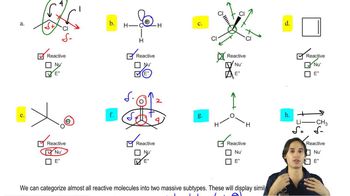
Nucleophile or Electrophile

Lone Pairs and Bond Formation

Lone pairs are pairs of valence electrons that are not involved in bonding and can participate in chemical reactions. In the context of the reaction, the lone pair on the cyanide ion is crucial for the proton transfer, as it allows the nucleophile to bond with the proton from HCl. Identifying and utilizing lone pairs is key to understanding reaction mechanisms in organic chemistry.
Recommended video:
Guided course
02:04
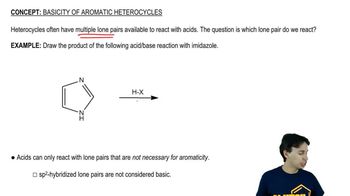
Heterocycles - Which lone pairs react?