Ch. 4 - Acids and Bases: Electron Flow
Mullins - Organic Chemistry: A Learner Centered Approach 1st Edition
Mullins1st EditionOrganic Chemistry: A Learner Centered ApproachISBN: 9780137566471Not the one you use?Change textbook
Chapter 3, Problem 30a

Given that the indicated pKa values correspond to the acid dissociation reactions shown, calculate the ratio of acid to conjugate base for the reactions shown.
(a)

Verified step by step guidance
1
Step 1: Recall the relationship between pKa and the ratio of acid to conjugate base. The Henderson-Hasselbalch equation is given as: pH=pKa+log([A-][HA]), where [HA] is the concentration of the acid and [A⁻] is the concentration of the conjugate base.
Step 2: Rearrange the Henderson-Hasselbalch equation to isolate the ratio of acid to conjugate base: [HA][A-]=10(pKa-pH).
Step 3: Identify the pKa value from the problem. The pKa of the acid is given as 20.
Step 4: Determine the pH of the solution. If the pH is not explicitly provided, it must be assumed or calculated based on additional information. For example, if the solution is neutral, the pH is 7.
Step 5: Substitute the pKa and pH values into the rearranged equation to calculate the ratio of acid to conjugate base. This will yield the ratio [HA][A-].

Verified video answer for a similar problem:

This video solution was recommended by our tutors as helpful for the problem above.
Was this helpful?

Key Concepts

Here are the essential concepts you must grasp in order to answer the question correctly.

pKₐ and Acid-Base Equilibrium

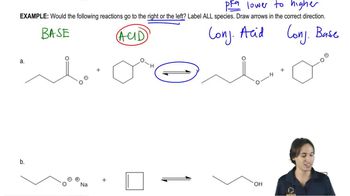
pKₐ is a measure of the strength of an acid in solution, defined as the negative logarithm of the acid dissociation constant (Kₐ). A lower pKₐ value indicates a stronger acid, which dissociates more completely in solution. Understanding pKₐ is essential for calculating the ratio of acid to conjugate base, as it directly influences the equilibrium position of the acid-base reaction.
Recommended video:
Guided course
04:00
Determining Acid/Base Equilibrium

Henderson-Hasselbalch Equation

The Henderson-Hasselbalch equation relates the pH of a solution to the pKₐ of the acid and the ratio of the concentrations of the conjugate base and the acid. It is expressed as pH = pKₐ + log([A⁻]/[HA]). This equation is crucial for determining the ratio of acid to conjugate base, as it allows for the calculation of this ratio based on the known pH and pKₐ values.
Recommended video:
Guided course
05:02
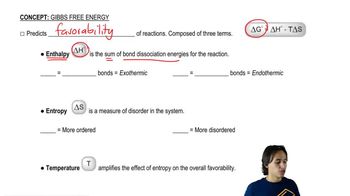
Breaking down the different terms of the Gibbs Free Energy equation.

Acid-Base Reaction Dynamics

Acid-base reactions involve the transfer of protons (H⁺) between species, leading to the formation of conjugate acids and bases. The dynamics of these reactions are influenced by factors such as concentration, temperature, and the presence of other ions in solution. Understanding these dynamics is important for accurately calculating the acid to conjugate base ratio, as it affects the equilibrium state of the reaction.
Recommended video:
Guided course
02:49
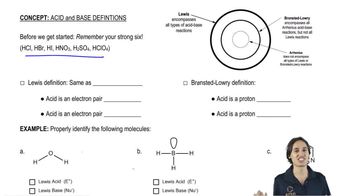
The Lewis definition of acids and bases.