Ch. 4 - Acids and Bases: Electron Flow
Mullins - Organic Chemistry: A Learner Centered Approach 1st Edition
Mullins1st EditionOrganic Chemistry: A Learner Centered ApproachISBN: 9780137566471Not the one you use?Change textbook
Chapter 3, Problem 31

Hydrogen gas (H2) has a relatively high pKa value. Is it a stable or unstable acid? Do you expect it to participate in acid–base reactions?

Verified step by step guidance
1
Understand the concept of pKₐ: The pKₐ value is a measure of the strength of an acid. A high pKₐ value indicates a weak acid, meaning it does not easily donate protons (H⁺) in solution.
Analyze the pKₐ value of H₂: Hydrogen gas (H₂) has a very high pKₐ value, which suggests that it is an extremely weak acid and does not readily act as a proton donor.
Determine stability: Since H₂ does not easily lose protons, it is considered a stable molecule in terms of acid-base behavior.
Evaluate participation in acid-base reactions: Due to its high pKₐ and weak acidic nature, H₂ is unlikely to participate in acid-base reactions under normal conditions. It is more likely to act as a reducing agent in redox reactions rather than as an acid.
Conclude: Hydrogen gas (H₂) is a stable acid with a high pKₐ value and does not typically participate in acid-base reactions, as it does not readily donate protons.

Verified video answer for a similar problem:

This video solution was recommended by our tutors as helpful for the problem above.
Was this helpful?

Key Concepts

Here are the essential concepts you must grasp in order to answer the question correctly.

pKa Value

The pKa value is a measure of the strength of an acid in solution, indicating how easily it donates protons (H⁺ ions). A high pKa value suggests that the acid is weak and does not dissociate significantly in water, meaning it is less likely to release protons. In the case of hydrogen gas (H₂), its high pKa indicates that it is not a strong acid.
Recommended video:
Guided course
07:45
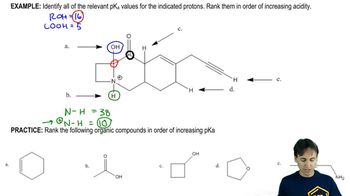
Identifying pKa values

Acid Stability

Acid stability refers to the tendency of an acid to remain in its protonated form versus dissociating to release protons. A stable acid will have a lower tendency to lose its protons, while an unstable acid will readily dissociate. Given that H₂ has a high pKa, it is considered a stable acid, as it does not easily participate in acid-base reactions.
Recommended video:
Guided course
03:43
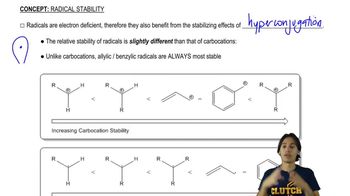
The radical stability trend.

Acid-Base Reactions

Acid-base reactions involve the transfer of protons between species, where acids donate protons and bases accept them. The participation of a substance in these reactions depends on its ability to act as an acid or a base. Since hydrogen gas (H₂) is a weak acid with a high pKa, it is unlikely to participate significantly in acid-base reactions under normal conditions.
Recommended video:
Guided course
02:49
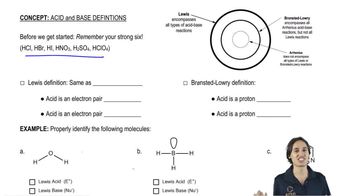
The Lewis definition of acids and bases.