Design an acid–base extraction scheme to separate a mixture of the basic amine N,N-dimethylaniline and naphthalene.
Ch. 4 - Acids and Bases: Electron Flow

Mullins1st EditionOrganic Chemistry: A Learner Centered ApproachISBN: 9780137566471Not the one you use?Change textbook
Chapter 3, Problem 29
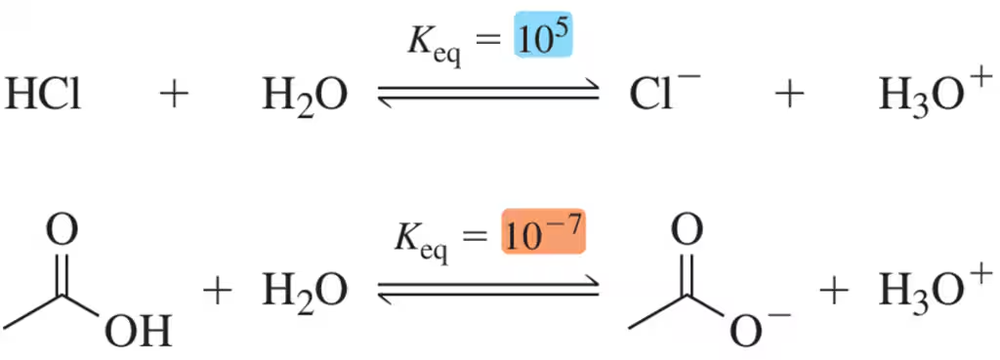
Given the following Keq values, how much stronger of a base is acetate (CH3CO2-) than chloride (Cl⁻)?

Verified step by step guidance1
Step 1: Understand the relationship between K_eq and base strength. The equilibrium constant (K_eq) is related to the acid dissociation constant (K_a) of the conjugate acids. A stronger base corresponds to a weaker conjugate acid, which has a smaller K_a value.
Step 2: Identify the conjugate acids of the bases in question. Acetate (CH₃CO⁻₂) is the conjugate base of acetic acid (CH₃COOH), and chloride (Cl⁻) is the conjugate base of hydrochloric acid (HCl).
Step 3: Use the formula K_a = K_eq for the dissociation of the conjugate acid. Compare the K_a values of acetic acid and hydrochloric acid to determine the relative base strength of acetate and chloride.
Step 4: Calculate the ratio of the K_a values. The relative base strength can be determined by comparing the inverse of the K_a values (since base strength is inversely proportional to acid strength). Use the formula: \( \text{Relative base strength} = \frac{K_{a, \text{HCl}}}{K_{a, \text{CH₃COOH}}} \).
Step 5: Interpret the result. The larger the ratio, the stronger acetate is as a base compared to chloride. This ratio quantifies how much stronger acetate is as a base than chloride.

Verified video answer for a similar problem:
This video solution was recommended by our tutors as helpful for the problem above.
Video duration:
4mWas this helpful?
Key Concepts
Here are the essential concepts you must grasp in order to answer the question correctly.
Equilibrium Constant (K_eq)
The equilibrium constant (K_eq) quantifies the ratio of the concentrations of products to reactants at equilibrium for a reversible reaction. A higher K_eq value indicates that the products are favored, suggesting a stronger tendency for the reaction to proceed in that direction. In the context of acids and bases, K_eq can help determine the relative strengths of different bases.
Recommended video:
Guided course
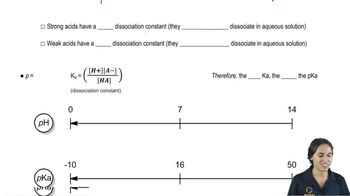
The relationship between equilibrium constant and pKa.
Acidity and Basicity
Acidity refers to the tendency of a substance to donate protons (H⁺), while basicity refers to the ability to accept protons. The strength of a base can be inferred from the K_eq of its conjugate acid; a stronger base corresponds to a weaker conjugate acid. Understanding the relationship between acids and bases is crucial for comparing the basicity of acetate and chloride.
Recommended video:
Guided course
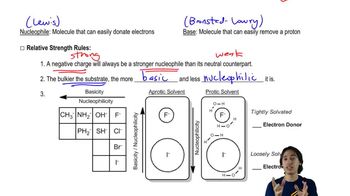
Understanding the difference between basicity and nucleophilicity.
Conjugate Acid-Base Pairs
Conjugate acid-base pairs consist of two species that differ by the presence of a proton. For example, acetate (CH₃CO⁻₂) is the conjugate base of acetic acid (CH₃COOH), while chloride (Cl⁻) is the conjugate base of hydrochloric acid (HCl). The strength of the conjugate acids can be compared using their K_a values, which directly influences the basicity of their corresponding bases.
Recommended video:
Base Pairing Concept 1
Related Practice
Textbook Question
1353
views
Textbook Question
Given the following Keq values, how much stronger of an acid is methanol (CH3OH) than acetylene (HC≡CH)?
1126
views
Textbook Question
Hydrogen gas (H2) has a relatively high pKa value. Is it a stable or unstable acid? Do you expect it to participate in acid–base reactions?
1549
views
Textbook Question
An unknown acid (HA) has been identified as very strong. What does this tell you about the stability of the conjugate base, A⁻? Is it strong or weak? Is it reactive or unreactive?
1100
views
Textbook Question
Given that the indicated pKa values correspond to the acid dissociation reactions shown, calculate the ratio of acid to conjugate base for the reactions shown.
(a)
925
views
Textbook Question
Given that the indicated pKa values correspond to the acid dissociation reactions shown, calculate the ratio of acid to conjugate base for the reactions shown.
(b)
1261
views